Sir La Cote Male Taile
Le Morte d'ArthurSir La Cote Male Taile enters the Arthurian court as an unnamed young man, but a mocking name becomes the label for a sequence of adventures. Malory’s account is singled out for its humor; the story’s movement from public ridicule and comic reversals to recognition at court also makes the knight an example of how Arthurian status can be earned through deeds.
Identity and Introduction
The chapter headings introduce a young man who comes to King Arthur’s court, where Sir Kay calls him La Cote Male Taile in scorn. The evidence does not supply his birth, family, or original name. His identity is instead established through the contrast between Kay’s dismissive naming and the later recognition he receives from Sir Launcelot and the court.
The next chapter places a damsel’s request at the center of his first undertaking: she asks for a knight to take on an inquest, which La Cote Male Taile accepts. The account thus introduces him through a task offered at court rather than through an account of his lineage or prior standing.
The Courtly Test and Knighthood
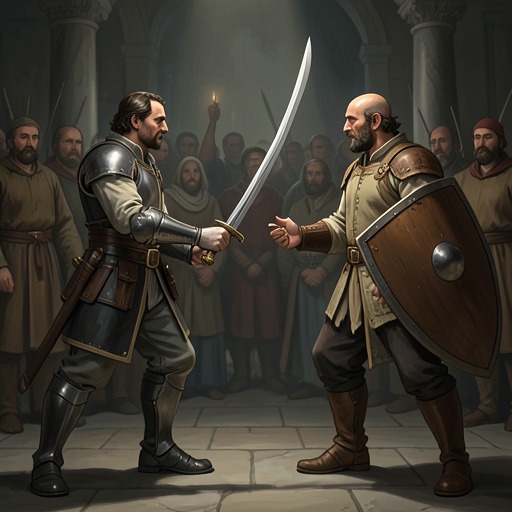
The chapter sequence distinguishes his acceptance of the damsel’s undertaking from his formal admission to knighthood. He desires the battle, receives permission to pursue it, and asks Sir Launcelot to make him a knight. He then departs, obtains a spear and shield from Sir Kay, and jousts and fights with Sir Launcelot. After telling Sir Launcelot his name, he is dubbed knight by him and rides on to overtake the damsel.
These episodes make recognition a process rather than an automatic consequence of arrival at Arthur’s court. The mocking name first marks his low standing there; his request for a demanding undertaking, combat, and appeal to Sir Launcelot for knighthood place him within the court’s chivalric order. The supplied account records this progression without specifying the full outcome of the damsel’s inquest.
Adventures and Recognition
The story’s later chapter headings trace further reversals. La Cote Male Taile overthrows Sir Dagonet, the king’s fool, but receives a rebuke from the damsel. He is subsequently taken prisoner and rescued by Sir Launcelot, who also overcomes four brothers. The episodes connect his advancement to both his own encounters and the assistance of a more established knight; they do not present his progress as uninterrupted triumph.
The account culminates in a change of standing: Sir Launcelot makes La Cote Male Taile lord of Castle Pendragon, after which he is made a Knight of the Round Table. The evidence establishes these honors but does not detail the terms or circumstances of his lordship beyond its connection to Sir Launcelot’s intervention.
Humor and Narrative Role
The critical discussion explicitly cites the adventures of La Cote Male Taile as an instance of Malory’s vein of humor, alongside the adventures of Beaumains and the pranks played on Sir Dinadan and Sir Dagonet. The episode involving Dagonet gives that characterization a concrete basis: La Cote Male Taile defeats the court’s fool, yet the damsel’s rebuke prevents the incident from reading as simple, unqualified acclaim.
A further comment on Malory’s sources notes that the story of Beaumains is an enlarged narration of the story of La Cote Male Taile, shaped by changes made through Malory’s own genius. La Cote Male Taile’s tale therefore has a particular place in the book’s narrative architecture: it is both a comic adventure in its own right and a source-story whose later expansion is identified as an act of adaptation. The available evidence supports this connection, but not a fuller reconstruction of how the two narratives correspond.